 Add to Chrome
 Add to Firefox
 Add to Edge
NeuroClaw Technical Report
Apr 27, 2026
Agentic artificial intelligence systems promise to accelerate scientific workflows, but neuroimaging poses unique challenges: heterogeneous modalities (sMRI, fMRI, dMRI, EEG), long multi-stage pipelines, and persistent reproducibility risks. To address this gap, we present NeuroClaw, a domain-specialized multi-agent research assistant for executable and reproducible neuroimaging research. NeuroClaw operates directly on raw neuroimaging data across formats and modalities, grounding decisions in dataset semantics and BIDS metadata so users need not prepare curated inputs or bespoke model code. The platform combines harness engineering with end-to-end environment management, including pinned Python environments, Docker support, automated installers for common neuroimaging tools, and GPU configuration. In practice, this layer emphasizes checkpointing, post-execution verification, structured audit traces, and controlled runtime setup, making toolchains more transparent while improving reproducibility and auditability. A three-tier skill/agent hierarchy separates user-facing interaction, high-level orchestration, and low-level tool skills to decompose complex workflows into safe, reusable units. Alongside the NeuroClaw framework, we introduce NeuroBench, a system-level benchmark for executability, artifact validity, and reproducibility readiness. Across multiple multimodal LLMs, NeuroClaw-enabled runs yield consistent and substantial score improvements compared with direct agent invocation. Project homepage: https://cuhk-aim-group.github.io/NeuroClaw/index.html

Brain Cortical Functional Gradients Predict Cortical Folding Patterns via Attention Mesh Convolution
May 21, 2022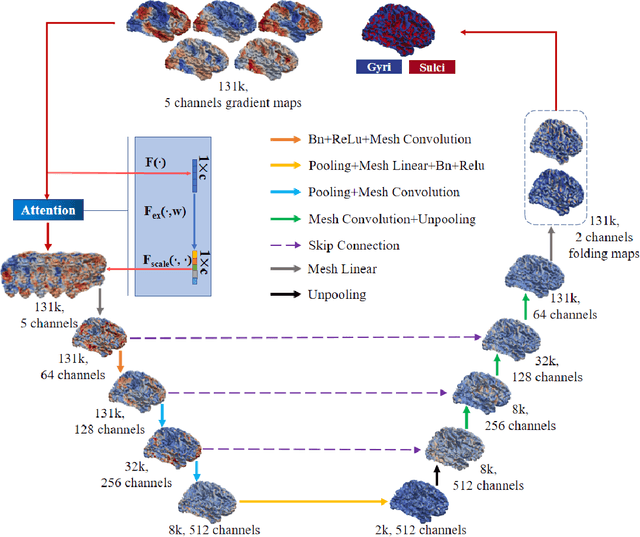
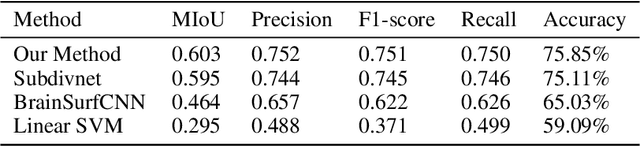
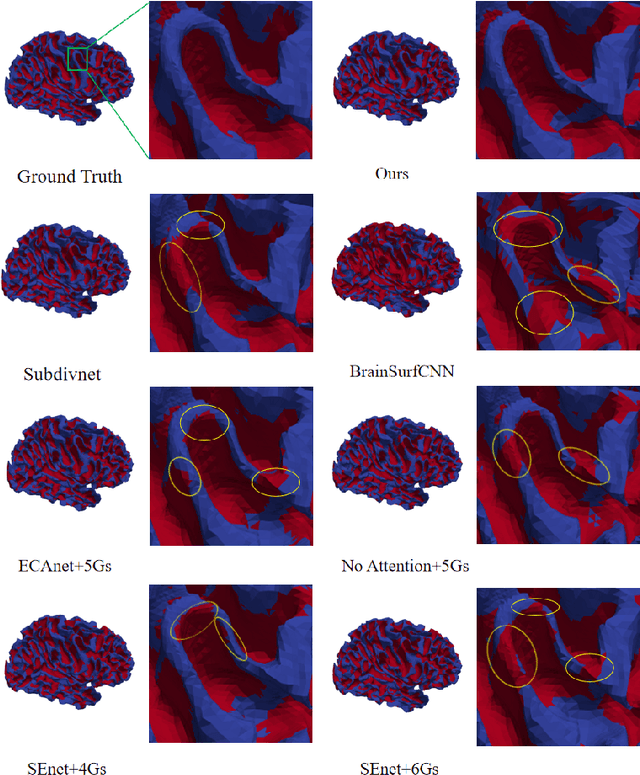
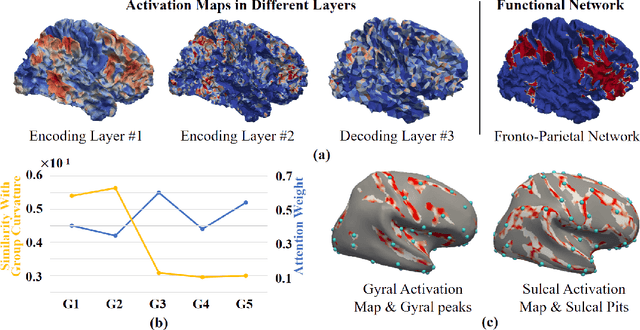
Since gyri and sulci, two basic anatomical building blocks of cortical folding patterns, were suggested to bear different functional roles, a precise mapping from brain function to gyro-sulcal patterns can provide profound insights into both biological and artificial neural networks. However, there lacks a generic theory and effective computational model so far, due to the highly nonlinear relation between them, huge inter-individual variabilities and a sophisticated description of brain function regions/networks distribution as mosaics, such that spatial patterning of them has not been considered. we adopted brain functional gradients derived from resting-state fMRI to embed the "gradual" change of functional connectivity patterns, and developed a novel attention mesh convolution model to predict cortical gyro-sulcal segmentation maps on individual brains. The convolution on mesh considers the spatial organization of functional gradients and folding patterns on a cortical sheet and the newly designed channel attention block enhances the interpretability of the contribution of different functional gradients to cortical folding prediction. Experiments show that the prediction performance via our model outperforms other state-of-the-art models. In addition, we found that the dominant functional gradients contribute less to folding prediction. On the activation maps of the last layer, some well-studied cortical landmarks are found on the borders of, rather than within, the highly activated regions. These results and findings suggest that a specifically designed artificial neural network can improve the precision of the mapping between brain functions and cortical folding patterns, and can provide valuable insight of brain anatomy-function relation for neuroscience.